


Latest Episodes

So this is one of the the brilliant things that our event director Gary Dempsey is very keen on, the fact that when you attend FinTech Meetup Europe, you can do everything.
And we work really hard to make that scheduling appropriate. When the talks are happening, nothing else is running. We protect it. We make it so this giant event turns into a lovely summit where you can actually have pushing the needle conversations and then pushing the envelope hopefully, financially when it comes to your your meetings afterwards. Everyone can relax and go to the actual track talks where we get into the nuts and bolts of how we're going to improve Europe and European financial institutions. and then obviously the the extracurricular and the parties happen after all of that too.




I mean, everyone has to renew their motor insurance every year and you have to go through those 60 questions every year, and in between three different platforms in trying to find a comparison, find the best quote for you.
And that was the frustration when I had to deal with those things.

After having been in events for over a decade, I had worked on events that talked about technology and yet, as far as using technology for the event itself, I felt that there was a bit of a gap there.
And so then when I saw what Fintech Meetup was doing in terms of using technology to maximise meeting the right people or being exposed to the right ideas, you know, I thought that just took that to a new level: it was a financial technology conference that actually used technology.
And so, as an example, we had 4,000 people at the event and we had over 43,000, 44,000 meetings scheduled!



Part of the reason the product's flourishing is because of these qualification processes. What we're looking at is the asset, right?
What's the value of it today? How much is that mortgage? How much equity is there in it? Once we can establish that, then we start actually looking at the homeowner.
It's far less restricted because there's no monthly payment.


MEET THE HOST
Brendan has worked in lending for twenty years, on three continents and across the credit life cycle.
Latest Articles

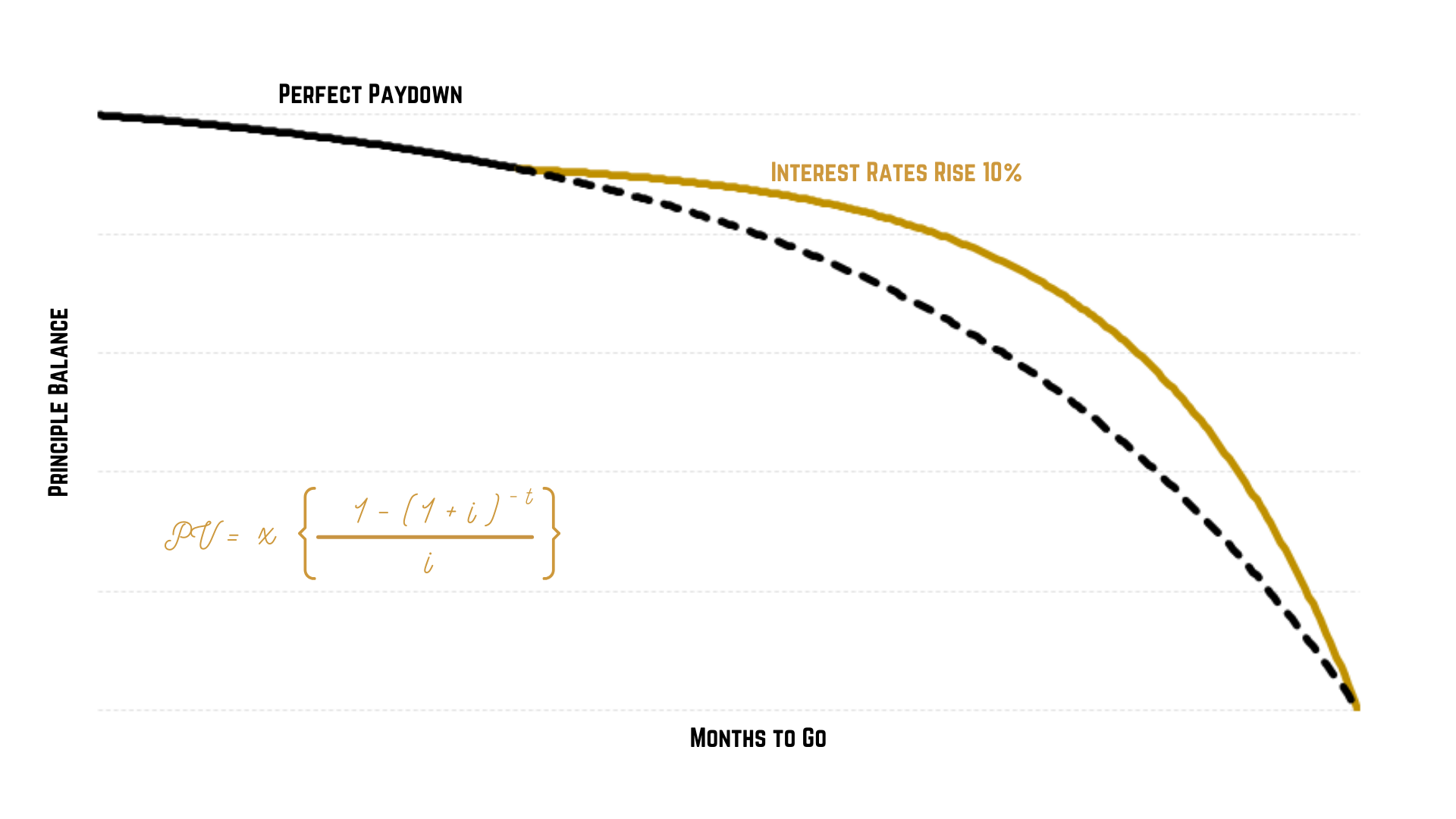
n my previous article on annuity curves, I used them to set initial loan amounts within the bounds of affordability but they also serve as a good illustration of why top-up campaigns, and to a lesser degree payment holidays, can be a value portfolio management tool.
The annuity curve describes the exponential drop of the principal balance, but it is important to not forget that monthly instalments are stable from day one to the end. This means that the drop in principal balances is also a drop in the ratio of interest generated per euro received over time.
PV = x [ (1 – (1 + i) -t )/ i ]
Where:
PV = the present value of the loan at a given point in time
x = the instalment amount
i = the interest rate
t = the number of terms remaining
You can shuffle this all around as needed, so that: if the PV is lower than the actual balance outstanding, a customer is in arrears (in the old days I had to do this sometimes when we took on portfolios with questionable data hygiene but that’s seldom needed these days); if in collections, you need to reduce the instalment by a certain amount, you can see how many months the loan would be extended by; or, in the affordability context; if you have calculated the maximum monthly instalment and have a set term and price, what the largest affordable loan is.

A good credit history and money management skills speak to a consumer’s willingness to repay, affordability checks speak to their ability to repay. And, at least in theory, calculating a consumer’s ability to repay a loan should be the simpler of the two tasks, being that ‘ability’ is all about the numbers while ‘willingness’ requires us to get inside the borrower’s head to some extent. Of course, it is not so easy in the real world, but simply put, a consumer is able to repay a loan when they have more money available to meet their debt obligations than they need to keep those obligations up-to-date.

When, on the other hand, a customer of sufficient means to meet their debt obligations chooses not to, the lender must seek to adjust the customer’s attitude towards repaying the debt, rather than adjusting the repayment terms. Now, in the old days, lenders used to think that the best way to change a reluctant payer’s mind was by increasing the level of aggression - he who shouts loudest, gets paid. But, as we heard in episode seven of How to Lend Money to Strangers, more and more lenders are realising that better processes attract more payments - he who makes collections easier, through online portals and customer-focused design, gets paid first.

That’s why, as in all areas of credit risk strategy, we should always be looking for ways to use data and analytics to create risk-based strategies in collections. In episode seven of How to Lend Money to Strangers I speak to Terry Franklin, who’s built the second half of his career on risk-based collections and I won’t try to match his expertise here, instead, you can treat this article as a quick introduction to the thinking that should underpin your first efforts
A risk-based collections strategy starts with the core belief that the decision to take any action should be informed by a mini cost-benefit trade-off; and that since not all customers will respond equally to any action and not all responses are equally valuable, a one-size-fits-all approach to debt management will always generate cases where too much is invested in collecting a bad debt alongside cases where a more effective approach would have been worth the extra spend.

This situation is doubly problematic as it doesn’t only lead to sub-optimal profit but also to a sub-optimal portfolio structure. The lowest risk customers (who are being over-charged) can be tempted to leave for cheaper competitor offers while the higher risk customers (who are being under-charged) will gravitate towards your product; leading to a riskier portfolio on average. Risk-based pricing addresses this by lowering the rates charged to low-risk customers and raising the rates charged to high-risk customers.
The key to successful risk-based pricing is, not surprisingly, a good understanding of risk so scorecards are once again at the heart of any strategy. But now we’re not thinking in terms of a binary approve/ decline decision. Instead, we’re thinking on a near-continuous spectrum where we accept everyone at the right price (only declining when the ‘right price’ is too high to be legally, ethically, or otherwise acceptable).

To actually be champion-challenger, it has to drive change, the challenger must be allowed to ascend to the throne. But, and this is perhaps a nuance better captured by the test-and-learn terminology, this has to be done in a controlled, scientific approach.
We don’t actually make a series of complete substitutions of one strategy for another, instead, we’re always running at least two strategies side-by-side. In examples, we often talk about 80% going down the champion stream and 20% going down the challenger but in reality, we set the split based on the degree of risk involved, how much of a variation we’d expect to see, the size of the portfolio and the sophistication of the team managing it. This is all based on statistical sampling theories, and I won’t go into them further in this article.

In theory, the mechanics of consumer credit are simple: you borrow a large sum of money at a low-interest rate, break it into smaller parcels, and then lend those out with interest rates set high enough to allow the gains made on the repaid loans to cover the losses you made on defaulted ones, plus the admin costs involved in keeping it all together.
In practice, of course, that is easier said than done.

That’s the ‘when’ answer to the future question. To answer the ‘what’ question, we need a ‘bad definition’. We talk about ‘bad’ because in lending risk it is usually based on a level of delinquency (often whether an account goes more than 90 days past due) but it is really a definition of the activity we’re trying to predict. There are even occasions where we might actually be looking for a positive outcome: for example, in a late-stage collections score we may target consumers who actually make a payment.
In all cases, we want to pick an outcome that is sufficiently common to create a workable population but also stable enough to minimise noise. So even though an ever 30+ bad definition would capture more bads, many consumers who miss one payment might do so for administrative reasons or might otherwise be able to cure so mixing them into the population would only dirty the waters. At least that’s the case for something like a credit card. In a product like a bank overdraft, where consumers who miss one payment invariably miss more, and where missed payments are less common overall, an ever 30+ bad definition might be perfect.